
For a Japanese Pokémon card, keep the Japanese printing as the starting point. Read the small card number and set information, then check the language and finish. A translated Pokémon name or familiar artwork does not establish an English equivalent.
The name is only the beginning.
A Pokémon can appear on many cards across sets and years. Even similar artwork can exist in multiple printings. The set and collector number help distinguish these versions.
Keep the printed language in view.
English and Japanese releases may have different set structures, numbers and market demand. A price for an English card is not automatically the native price of a Japanese, French or German version.
Look closely at finish and edition.
Holographic treatments, reverse holo finishes, stamps and promotional versions can change what you are comparing. Check which variant a provider’s quote describes before drawing a conclusion.
Understand uneven coverage.
Not every catalog or marketplace covers every card in every language. DexScan uses available catalog and pricing information; missing data is a limitation to acknowledge, not a reason to invent a precise value.
Build a useful collection record.
Record the match you actually own. Keep condition and quantity consistent so that collection totals remain interpretable. Prices change, and displayed values should be treated as estimates of market context.
Build the catalogue query in the language you can read
Start with the visible collector number. If you cannot type the name, use the set code and the full number, including the suffix. Compare the card image after the search and check that the printed text belongs to the right language. A translation can tell you the Pokémon’s name without telling you which physical card you have.
Keep separate records for equivalent art
Suppose your binder has an English and a Japanese card with a similar illustration. Save each under its own set and number, even if you group both under a character theme. If you price the pair, make sure each reference applies to that print. A currency conversion between markets cannot substitute for a missing match.
Read a price missing its language as a broad reference
Some sources group prints or do not expose the language of every underlying observation. If the quote does not say what it covers, avoid attributing it to your copy. Check offers with the language marked and visible photos. Keep condition, finish and shipping comparable when basing a buying decision on those offers.
What if search shows a translated name first?
Cross-check the set and lower text against your card. A label translated for the interface does not necessarily change the printed language of the entry. Type the collector number manually if the camera result remains ambiguous. If there is no exact price, keep the identification and the valuation as separate records.
A Japanese scan, checked against the card
The recording below shows a Japanese card with the printed number 071/193. Keep that number with the visible set code and Japanese text when checking the result. Matching a number without its set can lead you to a different card.
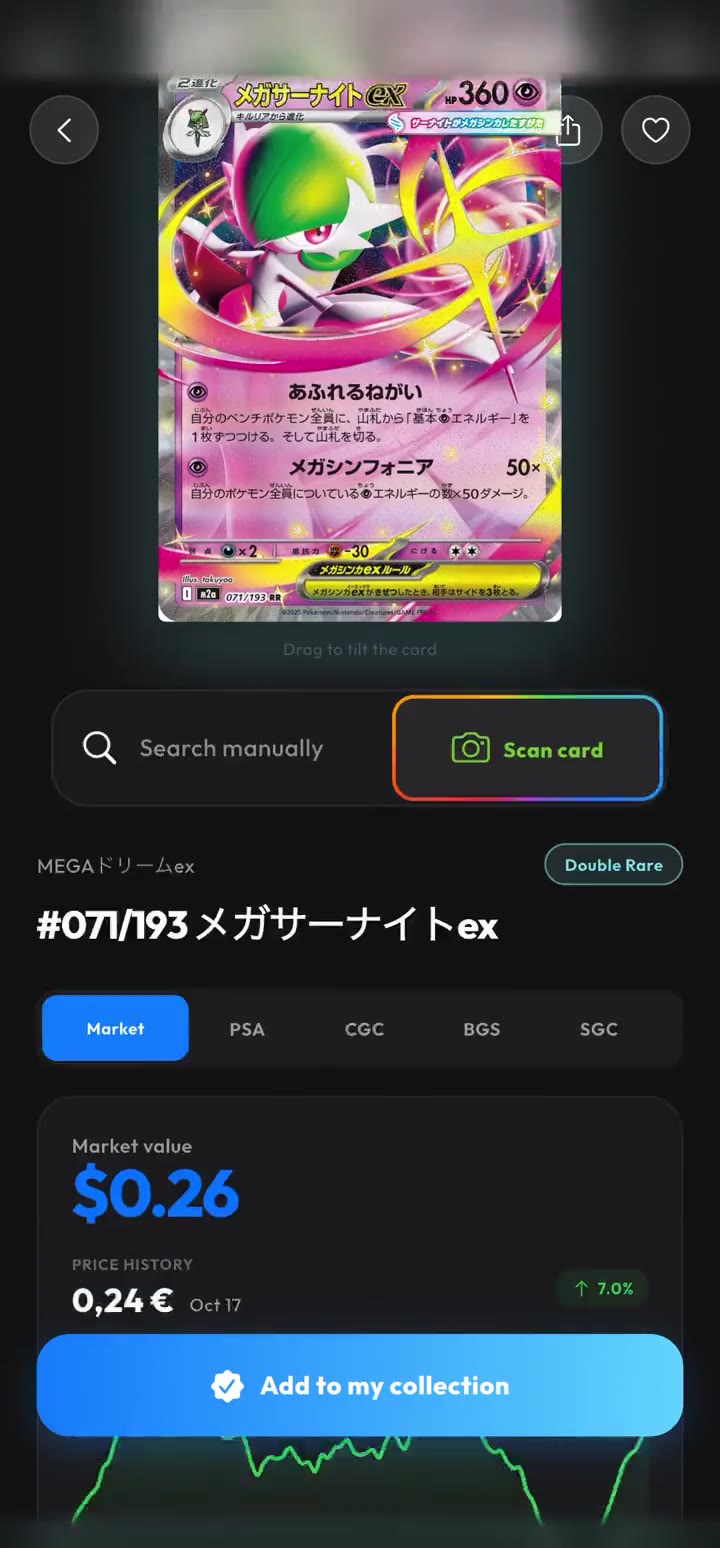
| Detail | Why keep it? |
|---|---|
| Printed language | A translated name should not silently change which market or printing you are checking. |
| Set symbol or code | The card number is meaningful within its release. Layouts differ between eras. |
| Collector number | Copy all relevant digits and letters. Check the denominator where printed. |
| Finish or stamp | A holo, reverse holo or stamped version may be a separate variant. |
Once the match is right, read how to check a Pokémon card’s value. Changing the display currency does not turn an English market reference into Japanese-market evidence.
What to do next
Keep the original set and printed number with the card even if your interface translates the Pokémon’s name.